Infographic: Healthy Look at The World of Vitamins
Check out this in-depth infographic into the world of vitamins by 16 Best.

Check out this in-depth infographic into the world of vitamins by 16 Best.
Pet manufacturers have been racking up the sales from their pet foods over the past few years. They have been doing so well that they are now growing faster than packaged human food sales. The video above digs into a little more detail on just how quickly pet food sales are growing.
The latest acquisition in the pet food space shows how big pet food brands can be. General Mills recently acquired Blue Buffalo for $8 billion. Mars also purchased VCA pet care provider in 2017 for $9 billion to go with their purchase of IAMs for $3 billion 2014.
The $30.6 billion U.S. pet food market is expected to grow by 2.3% over the next five years compared to 1% in packaged human food. The fast-growing pet food market is not slowing down anytime soon, and investors want to grab profits while the industry is hot.
Why does NutriFusion care about the pet food market? We developed a patent-pending method for stabilizing the naturally occurring vitamins in fruits and veggies. Premium pet food manufacturers are in love with our product because now they don’t have to add synthetic supplements to their fantastic products. With our grandfusion blends, you can dial in the exact amount you need without losing large percentages in the production process. Interested in learning more? Download our GrandFusion for Pet Resource kit today!
Reading Time: 2 minutes
Starbucks released this week that it is working with blockchain technology to create a “bean to cup” tracking system. The innovation is driven by the consumer’s desire for more transparency into where food and beverages come from. Starbucks is launching the pilot program to track coffee beans from Costa Rica, Rwanda, and Colombia.
The premium coffee company believes that blockchain’s “traceability technology” pairs well with their commitment to ethically sourced coffee and ecologic sustainability. Starbucks believes the technology will enable them to strengthen their supply chain and relationship with consumers.
The blockchain pilot program will go through multiple phases over the next two years. The pilot will fall in line with the Sustainable Coffee Challenge that the company championed with Conservation International in 2015. The company plans to share its results with the public.
The traceability of coffee beans to the cup is a noble cause by Starbucks, but it is worth noting that there are still some shortcomings with blockchain technology when applied in the food industry. Food supply chain experts still believe the “winning” blockchain application has yet to be developed for the food industry.
There are currently issues with entirely tracking that ingredient to the final product in many cases. IBM is working on a few innovations to help solve this issue. They believe that “cryptographic anchors” may be the solution in the next five years. Anchors would include microscopic, digestible ink dots on products to verify the authenticity of the final product within the supply chain.
While there are a few shortcomings, Starbucks is again leading the way with technology in the food industry. It will be interesting to see how blockchain works for them over the next few years.
Inspired by www.ciodive.com
Reading Time: 4 minutes
People who are following a plant-based diet often overlook their intake of B-Vitamins. But while many people focus on protein and calcium, these vitamins are essential as this group has a direct impact on your overall health from your heart, mood, to your digestion. These vitamins are used up for the production of healthy red blood cells, and they are also used to maintain the function of the cardiovascular and nervous system.
B-Vitamins are essential to the body as this group of vitamins is used for the different physiological functions of the body. They are naturally found in food, and they are water-soluble except for Vitamin B-12. Aside from being water-soluble, these vitamins are destroyed by heat, so foods that are overcooked and highly processed contain lower amounts of B-Vitamins.
Eating a nutritious and well-balanced diet is the best way to get your daily dose of B-Vitamins except for Vitamin B-12. Unfortunately, Vitamin B-12 is obtained from bacteria in the soil and the condition of our soil today is getting more impoverished due to intense synthetic agricultural practices. B12 can be found in a few plants and NutriFusion has developed a process to concentrate and stabilize naturally occurring B12, which once believed to be unobtainable in whole food sources. While you can get B Vitamins from eggs, milk, and red meat, plant sources are the best as you can also get other benefits such as antioxidants. Below are significant plant-based, whole food sources of for B-Vitamins.
Contrary to what most people think, a deficiency in B-Vitamins can spell serious health problems such as anemia, constipation, heart problems, brittle nails and hair, lack of appetite, and poor digestion. And since B-Vitamins also affect the mood of individuals, people who lack these essential nutrients may also suffer from depression, fatigue, poor memory, confusion, moodiness, and anxiety. With the many effects of B-Vitamins deficiency, it is important to know which foods great sources are so that you always get your daily dose of this important and highly underrated group of vitamins.
Inspired by www.onegreenplanet.org
Did you know that NutriFusion developed a process to stabilize and concentrate the naturally occurring vitamins in fruits and vegetables into powder form? With the GrandFusion product line, food and beverage manufacturers can easily add essential micronutrients to their products without impacting the flavor or texture of the end product. Interested in learning more? Download our GrandFusion R&D kit to get started!
Reading Time: 3 minutes
With space becoming limited in urban areas, people are looking for ways to start indoor farms. Vertical farming is popular in urban areas because you can grow food in vertically-inclined surfaces or layers. Buildings and warehouses are being transformed to create vertical indoor farms.
When it comes to vertical farming, startup company Bowery is taking the lead by building a facility that allows people to do indoor vertical farming. The facility will be in Kearny, New Jersey and what makes this facility different is that it will be the most tech-savvy in the world. The company was able to raise $20 million from investors like GGV, General Catalyst, and GV to build its new indoor farm.
The new facility can grow 30 times more than current indoor farms and it can supply 100 types of leafy greens to its customers. Recently, the company partnered with companies like Foragers and Whole Foods. The company is increasing efficiency by using machine learning, robotics, and predictive analytics to grow food. Bowery has developed a proprietary software system with a robust network to automate the farming practices.
Bowery CEO, Irving Fain, noted that the software is the brains of the farm. It can make small adjustments to changes in water flow, humidity, temperature, and light intensity to grow the best crops. The use of precision-level technology to control the environmental parameters is seldom used in agriculture and the company is keen on being the first to deliver this technology at an unparalleled level.
With this technology, Bowery is able to be 100 times more efficient when it comes to growing food compared to a square-foot of farmland. There is also no downtime as Bowery can grow food all year round and is not at the mercy of the changing seasons. The startup also does not use agri-chemicals like synthetic pesticides and fertilizers to grow food but surprisingly is able to produce higher yields for each crop cycle. This is definitely not doable when implemented out in the open field.
The crops are grown through a system called hydroponics. This “soil-less” system uses substrates such as pebbles and rocks submerged in nutrient-rich waters to grow crops. But while the National Organic Standards Board has voted hydroponics as organic, Bowery is focused on growing post-organic food. The thing is that organic produce still uses pesticides, but Bowery does not use it at all.
This urban vertical farm provides food immediately to the neighborhood. Since the farm is located in the heart of New Jersey, the food produced goes to the local tri-state area. And since the food is grown close to the consumers, there are not so many players that sit between the food and the consumers which keeps the cost of the food down. If more of these farms are built in the United States, it can provide fresh and healthy foods to all income levels and areas.
Inspired by fortune.com
Reading Time: 4 minutes
Many people are willing to pop vitamin pills and supplements since they expect them to provide the body with essential vitamins and minerals that the body needs to function correctly. In fact, an article published in the journal JAMA noted that 52% of Americans reported that they take in at least one (1) dietary supplement a day.
While there are so many dietary supplements sold in the market these days, is taking supplements effective? Dr. JoAnn E. Manson, chief of preventive medicine at Brigham and Women’s Hospital, seems to think otherwise.
The popularity of supplements is part of the marketing ploy for many companies. Many detractors of vitamin pills and supplements believe that the best way to get the necessary micronutrients into the body is by eating the right kinds of food. A healthy diet is the best way for the body to absorb and get a wide array of nutrients into the body. Below are the few key things that you need to know when it comes to the consumption of synthetic vitamins and supplements.
A well-balanced diet is a great way to get essential micronutrients from food. Make sure that your diet is comprised of whole grains, fruits, vegetables, lean meats, seafood, nuts, and seeds. Not only will you get micronutrients but also fiber, antioxidants, and many other benefits. Make sure that you avoid foods that are highly processed as they are stripped of essential vitamins, minerals, and fiber.
Many people believe that taking high doses of supplements such as folic acid, beta-carotene, and Vitamin E is beneficial to the body. However, clinical trials have noted that overdosing on supplements can have harmful side effects such as a stroke. Our bodies are not entirely sure what to do with a synthetic form of a nutrient and can sometimes react to high dosage.
If you believe that taking supplements can boost your immune system, then think again. So, if you have been popping Vitamin C supplements to ward off the flu, realize your magic supplement will not reduce the risk of developing flu or cold. However, there are some pieces of evidence that Vitamin C can shorten the symptoms of flu but only when taken in as food instead of supplements.
There is a lot of buzz going on about Vitamin D supplements and how it is vital to driving other processes in the body. While, studies have indicated that Vitamin D can reduce the risk for developing cancer, stroke, and heart disease, the consumption of pill supplements is not necessary as you can get 600-800 IU of Vitamin D daily by sunbathing early in the morning. Other natural sources include mushrooms and milk.
While taking vitamins is not recommended for the general population especially those who are usually of good health, those who are in particular life stages or at high risk of developing diseases should consume supplements only if they are required by their physicians. For instance, people who suffer from osteoporosis can benefit from taking 1,000 IUs of Vitamin D but not too much as it can be linked to kidney stones especially if you are taking in calcium.
The conclusion here is to be careful about what supplements you are putting into your body. The best way to get the essential micronutrients you need is to consume them in whole foods. NutriFusion has figured out a way to help supplements companies create better products with whole food vitamins. Our powders concentrate the natural vitamins from fruits and vegetables into a blend that can be easily added to any product. Interested in learning more? Vist our supplements page.
Inspired by www.today.com
PacMoore recently released an interesting infographic on the differences between organic and non-GMO labels. Most consumers, as well as food brands, struggle to understand what is the difference. The certification and verification process is much different. Check out PacMoore’s infographic to learn more!

Inspired by https://www.pacmoore.com/organic-versus-non-gmo-labels/
Reading Time: 3 minutes
During the CAGNY conference in Florida, Food Dive sat down with ingredient manufacturer, Ingredion, to talk about insights into how CPG companies are planning for growth and adapting to changing consumer preferences. The CEO of Ingredion, Jim Zallie, believes that on-the-go consumption habits are the most challenging for the ingredient industry. The lucrative market opportunity is leading new players in the restaurant and retailer industry to compete with well-known CPG brands.
Jim Zallie told a consumer analyst group that the grab-and-go market, as well as food ordered online, has reached $110 billion globally. In just one year, from 2015 to 2016, the amount of U.S. on-the-go purchases grew by 56%. Zallie told the audience that this is critical to ingredient companies because of the importance of developing high-quality products that deliver the right texture and maintains heat.
Ingredion North American President, Jorgen Kokke says that texture claims on packaging have increased by over 90% in the past five years.
“We can talk about health trends… We can talk about cost and affordability and sustainability, but underneath all of that, [food] always has to taste good and be fun. And that’s where texture comes in. … We say it’s as important as flavor.”
Jorgen Kokke
Zallie believes there are “pockets of growth in the food anywhere space.” He points to the fresh refrigerated space as a critical example. The freshly prepared food category is generating over $25 billion in sales annually according to the Supermarket Guru. The clean label trend and simple ingredient trend play significant roles in the development of functional on-the-go foods. With 62% of consumers now looking for recognizable ingredients on the label, it’s imperative to use things they understand.
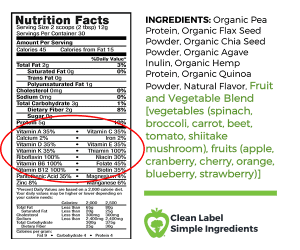
NutriFusion developed the GrandFusion product line for this very reason. We saw the way synthetic vitamins were reading on the label and thought there had to be a better way. With our products, consumers read fruits and vegetables instead of chemicals, so it makes a lot more sense to them. See the graphic below. If you are interested in learning more, visit our R&D page and download the GrandFusion resource kit to get started with product development.