• Link to LinkedIn
  • Link to Facebook
  • Email Us
  • Email Us
  • Call Us
  • Call Us
NutriFusion
  • Applications
    • All Blends
    • Food
    • Beverages & Drinks
    • Nutraceuticals
    • Pet Nutrition
    • Custom Superfood
  • R&D
    • Research & Development
    • Vitamin Deficiency
  • Active Research
  • About
    • About NutriFusion®
    • Certifications
  • Contact
  • News
    • Press Center
  • Podcasts
  • Blog
  • Store
  • Store
  • Click to open the search input field Click to open the search input field Search
  • Menu Menu

Archive for category: Supplements & Nutraceuticals

Packaged Facts Reports Stable Growth in the Natural Food Industry

in Beverages & Drinks, Consumer Packaged Goods, Food Business, Supplements & Nutraceuticals

Modern consumers are no longer driven only by the price and taste of food. With most consumers seeking healthy foods, their shopping behaviors have also changed. Today, American consumers consider safety, experience, social impact, transparency, as well as health and wellness when it comes to purchasing food. This is the reason why organic and natural foods are a growing niche in the food industry.

According to the report titled Natural and Organic Foods and Beverages in the US (5th edition), most consumers value the transparency and eco-conscious models of how their foods are made. Opting for natural and organic foods fulfill the needs of the customers.

Research Director of Packaged Facts, David Sprinkle, noted that this new behavior of consumers resulted in the rise of the organic and natural foods market. Packaged Facts estimated that the industry would earn $69 billion by the end of this year. This is 11% higher than the sales from last year.


The Industry Shift to Organic And Natural Foods

The growth of the organic and natural products has outpaced the sales of conventional food items. It is forecasted that the growth will be up to 70% from 2016 to 2021. This is the reason why big food manufacturers are shifting towards the natural and organic food niche. They hope to achieve this by overhauling their products or creating a new portfolio in the hopes of attracting consumers who lean towards natural and organic foods.

But what most big companies do not realize is that integrating organic and natural foods to their established brand can be quite challenging. While the market for organic food products is rising, it still has big shoes to fill. Conventional companies might find it difficult to look for clean ingredients because the suppliers are not quite there yet.

Big Food Companies Making Changes

Although there are some challenges present, investing in the natural and organic food niche is worth it. In fact, many big companies have seen stark improvements in sales after jumping into the natural and organic bandwagon.

For instance, Campbell Soup Co. announced to remove all artificial flavors and colors in its products by the end of 2018. Other companies that have plans to remove its artificial colors and flavors include Mondelez, General Mills, Mars Inc., Kraft Heinz, and Hershey Co. On the other hand, companies like WhiteWave Foods have pledged to use only organic ingredients in their products.

The food manufacturing industry has come a long way from using artificial flavors and colors in the past to using only natural ingredients. As consumer behavior continues to lean towards clean ingredients and healthy foods, the other main food manufacturing companies will follow suit–an action that will not only benefit food manufacturers but consumers as well.

Inspired by prnewswire.com

https://nf.simplygrandproperties.com/wp-content/uploads/2022/05/NutriFusion-Logo-New-1030x251.png 0 0 NF Admin https://nf.simplygrandproperties.com/wp-content/uploads/2022/05/NutriFusion-Logo-New-1030x251.png NF Admin2016-11-03 09:30:032016-11-03 09:30:03Packaged Facts Reports Stable Growth in the Natural Food Industry

Premium Packaging: The New Trend in Private Label

in Beverages & Drinks, Consumer Packaged Goods, Food Business, Supplements & Nutraceuticals

The food manufacturing industry is highly competitive right now, and private label brands are keeping big brands on their toes. Aside from using clean ingredients, another industry trend is premium packaging.

Packaging is considered by most the brand and forms the first impression of products at the shelf in stores and online. Private label is adopting premium packaging to increase the perceived quality of their products and increase brand loyalty.

What Is Premium Packaging?

Big retailers are relying on cutting-edge packaging to enhance their brands. Premium packaging is all about improving the presentation of the product to make it distinguishable from competitors. It reinforces the identity of the brand, thereby making the products more appealing to the consumers. But it is important to take note that premium packaging is not only about using heavy-duty and expensive materials, but it also considers convenience and sustainability.


The Elements of Premium Packaging

Creating premium packaging can be a challenging task. Companies need to consider many things in the design of the packaging to sell their product, identity, and brand. Certain things should be taken into consideration when creating premium packaging, and these include the following:

  1. technical design innovation
  2. the durability of packaging
  3. convenience
  4. consumer health and wellness
  5. eco-friendly materials

For instance, thinking about the use of eco-friendly materials is necessary for creating premium packaging since so many people are now conscious of the green movement. Today, many manufacturers look into the sustainability of their packaging as they aim to produce less waste.

Convenience is also another factor especially if the product is designed for a particular target market. For instance, products that are created for the elderly should be convenient enough so that they can open the packaging without the help of others.

The Benefits of Premium Packaging in Private Label

The idea of presenting a product or brand as “luxurious” depends on the type of packaging used. People opt for luxury products to maintain a certain social standard. But more than social standards, luxury packaging can also improve the consumer experience. Private label companies are interested in premium packaging for this primary reason. They are already beating competitors on price, but they want to compete on experience now.

For instance, when the first microwavable meals became popular, demand increased because of the attractiveness of quick meals. Today, microwavable meals are no longer attractive and are commonplace. The use of ceramic pots to contain microwavable meals are used to create a better eating experience.

It is inevitable for companies to change their product packaging. It is one of the marketing strategies that companies should do to ensure success. With the constant evolution of product packaging, it will continue to push private label manufacturers to innovate and stand out from the crowd.

Inspired by http://digital.foodmanufacturing.com

https://nf.simplygrandproperties.com/wp-content/uploads/2022/05/NutriFusion-Logo-New-1030x251.png 0 0 NF Admin https://nf.simplygrandproperties.com/wp-content/uploads/2022/05/NutriFusion-Logo-New-1030x251.png NF Admin2016-10-26 10:01:282016-10-26 10:01:28Premium Packaging: The New Trend in Private Label

Consumers Looking for More Plant-Based Proteins

in Beverages & Drinks, Consumer Packaged Goods, Food Business, Health & Nutrition, Supplements & Nutraceuticals

Where do you get your protein? The usual answer would be from meat and other animal products. Proteins are also found in plant sources, and they are gaining a lot of traction. In fact, 63% of Americans want to eat healthy by better understanding the ingredients found in their food. The preference of most consumers for natural and simple foods has led them to explore other food alternatives such as plant-based proteins.

Plant-Based Protein Beast Burger Beyond Meat NutriFusionPlant-Based Pulses: The New Meat

Although the sales of lean proteins in the United States have increased by 4.8% or $19.6 billion, many consumers are also buying pulses or grain legumes. Pulses are edible seeds made up of aggregates of peas, lentils, chickpeas, and other dried beans.

In a survey conducted by Nielsen, about 61% of the respondents opted for foods that have both high protein and fiber content where pulses are clearly spot on. And with the many health benefits attributed to eating pulses, it is no wonder why the United Nations declared this year (2016) as the International Year of Pulses.

Pulses are not only perfect for vegans and vegetarians. In fact, even carnivores can also take advantage of the many health benefits of pulses. But aside from nutritional and health benefits, people are now shifting to pulses because of its taste and eating convenience.

Why Are People Eating Pulses?

Health is becoming a priority for many American consumers these days. One of the most popular superfoods for health-conscious individuals is pulses.

There are different categories of consumers that consume pulses, and they vary in their income levels, dietary preferences, and life stages. However, the recent study conducted by Nielsen Homescan Consumer Moments indicated that most people who consume lentils are women who make up 70% of the respondents.

It is also important to take note that the manner of consumption of pulses indicated that consumers eat them at home.  In the study, 86% of the respondents consume legumes at home, and more are preparing them not as side dishes but as the main entrée. This means that many consumers today are taking control of their personal health by making time to cook their meals.


The Future of Pulses

Although there has been a rapid increase in popularity, the overall sales of some legumes have dropped significantly this year. For instance, while lentils and chickpeas are still dominating the sales chart with 11.1% and 64% growth respectively, other lentils like red, black, and white beans are on a steady decline.

The market for pulses in the United States is still very young. While the market is still experiencing slow growth for some of the seeds, well-known seeds like lentils and chickpeas are dominating the market. As more and more people appreciate the benefits of eating lentils, this food trend will continue to persist for years to come. It’s up to manufacturers to develop new plant-based alternatives that are tasty and excite consumers.

Inspired by nielsen.com

https://nf.simplygrandproperties.com/wp-content/uploads/2016/10/many-nuts-on-sack-Q6RV2JB-min.jpg 1030 1547 NF Admin https://nf.simplygrandproperties.com/wp-content/uploads/2022/05/NutriFusion-Logo-New-1030x251.png NF Admin2016-10-19 09:17:312016-10-19 09:17:31Consumers Looking for More Plant-Based Proteins

Developer Creates More Visual Food Data With Interactive App

in Beverages & Drinks, Consumer Packaged Goods, Food Business, Health & Nutrition, Supplements & Nutraceuticals

More consumers are reading food labels than ever before. Customers expect packaged foods to contain the appropriate and promised ingredients. A developer has reinvented food data by launching a new web app, Sage Project. Co-founded by Sam Slover and backed by the FDA, the Sage Project is an online platform that gives food data and labels a new visual understanding of what we are eating.


The Sage Project

The project deconstructs thousands of food products–both fresh and packaged–into a personalized, interactive platform that contains necessary information you would find in conventional food labels. The information accessed with this app includes nutrients, calories, allergens, vitamins, and ingredients. But aside from providing food data, the developer wanted to communicate the nutritional content and what it means in the context of the health of an individual. The app also contains information on how it affects the fitness goals and activity levels of a person.

The app itemizes all the ingredients regarding weight in a list. While it is straightforward enough, the developer also ensured that the ingredients and nutrients also change depending on the serving size. This gives consumers a clear idea of how much of a particular ingredient or nutrient they are getting from the food in a specific amount.


Why People Are Not Reading Food Labels

There is a big reason why most consumers do not read food labels. While it takes some time getting used to reading food labels, conventional food labels are downright boring to look at. In a study conducted by researchers from the University of Minnesota, they revealed that one of the biggest reasons why people are not looking at labels is because they do not have strong visuals.

To solve this problem, the Sage Project deconstructed the traditional food label into an infographic. A list of the five most abundant nutrients of the food product is located at the top of the page, while an analysis of the nutritional content is found beneath it.

The app also features the types of exercises needed to burn off a particular food item when eaten; while an annotated list of ingredients including allergens is found in the lower part of the screen. Since most of the consumers are not familiar with some of the ingredients used in making a product, there are information icons beside each ingredient that you can scroll through to understand that particular ingredient better.


The Drawbacks to The Sage Project Food Data

The Sage Project provides a lot of information, which is one of its drawbacks. Some people just want their food labels to be straightforward. With so much information, some people may find the entire app overwhelming. However, the visual appeal of the data makes it easy to comprehend for the more data savvy generation, millennials.


According to Angela Lemond from the Academy of Nutrition and Dietetics, consumers might experience information overload when using this app. But nevertheless, this app can be customized to fit any customers’ dietary restrictions as well as health goals. What matters is that this app can help a lot of people make the right health decisions when it comes to their food.

Inspired by wired.com

https://nf.simplygrandproperties.com/wp-content/uploads/2022/05/NutriFusion-Logo-New-1030x251.png 0 0 NF Admin https://nf.simplygrandproperties.com/wp-content/uploads/2022/05/NutriFusion-Logo-New-1030x251.png NF Admin2016-09-07 10:15:522016-09-07 10:15:52Developer Creates More Visual Food Data With Interactive App

New Research: Food Shopping Habits of Millennials

in Beverages & Drinks, Consumer Packaged Goods, Food Business, Infographics, Supplements & Nutraceuticals

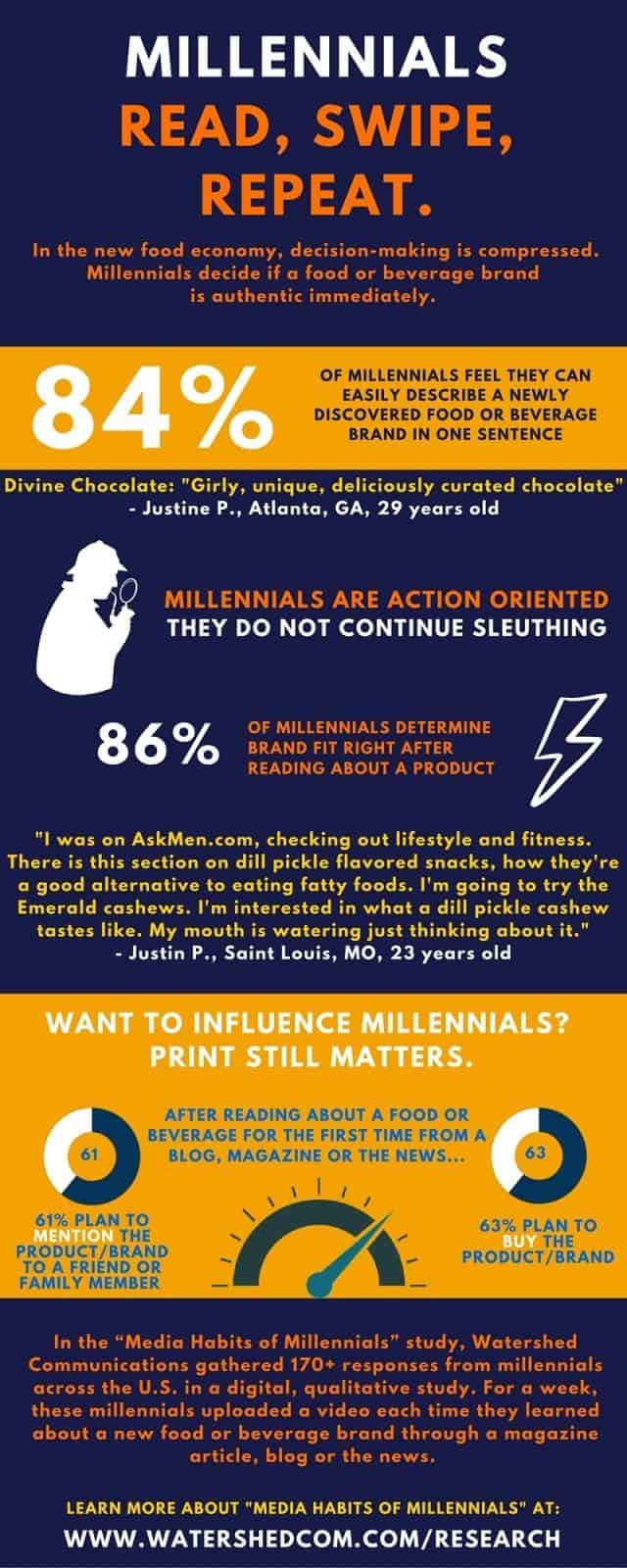
The food landscape is ever changing, and so does the behavior of people. Watershed Communications, a national brand strategy agency, conducted a study regarding the food shopping habits of Millennials. The participants, aged 18 to 35 years old, were asked to describe a food brand that they found authentic. They also had to answer questions related to their food shopping habits.

Millennials are considered the most highly engaged shoppers in all demographics. They are also the ones who have more shopping demands and higher capacities. With this study, companies will be able to understand the food shopping habits of Millennials so that they can apply the information in developing new products to meet their desires.

Food Shopping Habits Among Millennials Shows Branding Wins

Studies have found out that 84% of millennials can describe a particular brand or product that they have just discovered. They learn about brands by reading magazines, but they are keen on finding new brands through the internet. Once they have heard of a particular brand, 61% of millennials will share the information with their friends, family, and acquaintances while 63% plan to buy the product.

Millennials are consistent with the brands and products that they use. According to US food analyst Alexia Howard from the Stanford C. Bernstein, most millennials opt for products that are authentic, simple and consistent.

Millennials habits food shopping

The Need for Authenticity

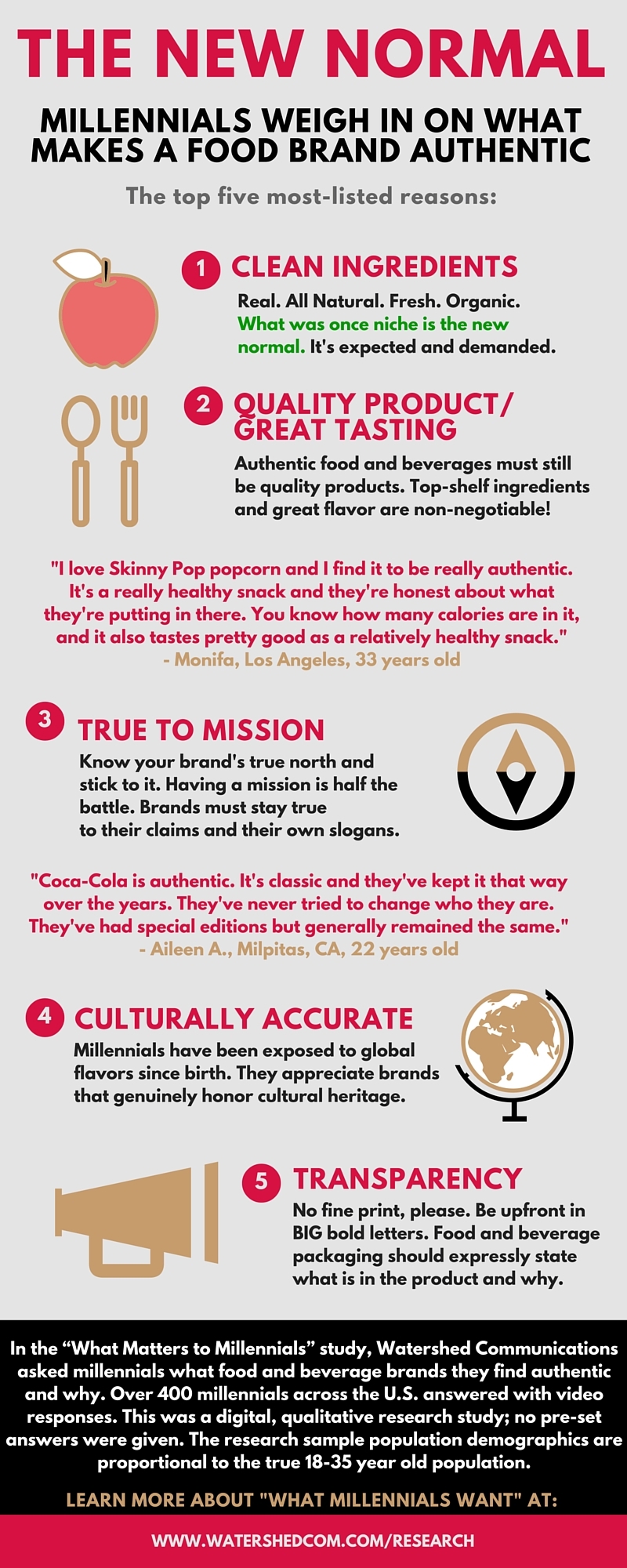
Millennials have a constant need for authenticity in their products. Authenticity of a brand can be difficult to define, but five characteristics determine the authenticity of a particular product as follows:

  • The use of clean ingredients: Clean ingredients refer to ingredients that are real, natural, organic, and fresh. Clean ingredients are expected and demanded by millennials to ensure that safety and quality of the product that they are buying.
  • High-quality products: Quality products use top-of-the-line ingredients. Quality food products should also have great flavor.
  • True to its mission:  Authentic brands should stay true to its mission. They should stick to their claims.
  • Culturally accurate: A lot of millennials are exposed to global brands, but many of them feel that brands that honor their cultural heritage are more authentic than those that try to appeal to a market audience that are thousands of miles away from them.
  • Transparent: Transparency is imperative in defining the authenticity of products. Transparency divulges the origin of the product and the processes that it has to go through before landing on your table.

Millennials make decisions instantaneously. They are also the most influential. For instance, a 35-year-old mother can make decisions for her children to purchase a particularly healthy snack or she can encourage her parents to buy a product that she has already tried and tested.  It is, therefore, necessary for companies to use this information to create products and a marketing strategy to attract them.

Inspired by businesswire.com


https://nf.simplygrandproperties.com/wp-content/uploads/2022/05/NutriFusion-Logo-New-1030x251.png 0 0 NF Admin https://nf.simplygrandproperties.com/wp-content/uploads/2022/05/NutriFusion-Logo-New-1030x251.png NF Admin2016-09-02 10:11:512016-09-02 10:11:51New Research: Food Shopping Habits of Millennials

Simple Ingredients are Attracting Consumers to Natural Products

in Beverages & Drinks, Consumer Packaged Goods, Food Business, Health & Nutrition, Kid's Health, Supplements & Nutraceuticals

Many consumers are not only more health conscious but are also becoming more careful shoppers. While many consumers still don’t look at the label, a growing group is focused on natural food and beverage products with simple ingredients.

The Clean Label Trend

There is an increasing number of people opting for clean labels. A clean label is simplifying the list of ingredients in a particular food and beverage product. It is a guiding purchasing behavior for future consumers, but it is a challenging call for food manufacturers.

This particular trend follows the five-ingredient rule which means that products should contain fewer and more recognizable ingredients to become attractive to many consumers. As this trend has evolved over time, efforts have also been made by many food and beverage manufacturers to use simple ingredients, and ensure that the ingredients used are as natural as possible.

Natural Ingredients are Simple Ingredients in Consumer Minds

With a lot of food products marketed as containing natural ingredients, many consumers find it difficult to define what “natural ingredients” means. Unfortunately, many food products claiming to be natural either have legitimate claims or just use buzzwords. The agency responsible for the ingredients’ definitions is the Food and Drug Agency (FDA).

So what are natural ingredients? Food writer Michael Pollan defines such ingredients as those that consumers can easily pronounce and recognize. These ingredients should be as close to their natural form and should not be overly processed nor should they contain additives like dyes or artificial preservatives.

The Demand for Natural Food Products

Clean labels are very popular throughout the industry and the demand for simple ingredients is influencing the sales of many food and beverage products. Many believe this trend is the leading reason for the organic & natural foods industry projected growth to experience a 14% rise in its total sales by 2020.

Unfortunately, this trend has also produced a lot of confusion among the consumers. According to global consumer research firm Mintel, more than 37% of the consumers remains confused about the information indicated in food labels, while 38% are skeptical of the information provided by these companies.

The solution to this confusion is to uphold transparency within the food industry so that this trend will resonate with all consumers. But how do food companies maintain transparency? Aside from making food labels comprehensible by using simple language, companies must reformulate their products using natural ingredients. Instead of using artificial sweeteners, natural alternatives may be employed. Food manufacturing companies can also look into their packaging and opt for a more sustainable look, instead of using plastic or foil packs.

This trend provides a tremendous opportunity for brands to increase revenue but also to connect with consumers. The cherry on top is brands will be seen as more trustworthy if they adopt simple ingredients and create clean labels for their products.

Inspired by fooddive.com

https://nf.simplygrandproperties.com/wp-content/uploads/2022/05/NutriFusion-Logo-New-1030x251.png 0 0 NF Admin https://nf.simplygrandproperties.com/wp-content/uploads/2022/05/NutriFusion-Logo-New-1030x251.png NF Admin2016-08-15 10:18:492016-08-15 10:18:49Simple Ingredients are Attracting Consumers to Natural Products

Small Rivals Assaulting Big CPG Brands for Market Dominance

in Animal Nutrition, Beverages & Drinks, Consumer Packaged Goods, Food Business, Supplements & Nutraceuticals

Gone are the days when owners of traditional consumer packaged goods (CPG) brands can sleep well at night. With small brands gaining traction today, brands like Nestle, Procter & Gamble, General Mills and Unilever are experiencing problems they didn’t see coming. The rise and dominance of small brands between 2011 and 2015 caused large conglomerate food companies to lose nearly 3% of their market share in the United States.  In the study conducted by data provider IRI and Boston Consulting Group, emerging local competitors are now being considered as threats to big multinational companies.

The Rise of Smaller Competitors

Why are large CPG companies suffering from decline? Marketing experts believe that size has something to do with it. One of the challenges of giant companies is their centralized decision-making processes and their consolidation of manufacturing processes. With the popularity of the brands themselves, companies have to spend millions of dollars in advertising and shelf placements at retailers.

On the other hand, advertising is also changing through time. TV advertising is no longer effective according to Nik Modi from RBC Capital Markets. With the rise and relevance of social media, it has provided an avenue for small brands to market their products to many people. In fact, hundreds of small brands have benefited from the rise of e-commerce as online sales have increased over the past five years.

Fast-Changing Market for CPG Brands

Many multinational giants find it hard to keep up with the fast-changing market trends. For instance, many people tend to patronize local companies producing essential products.  Ali Dibadj of Sanford C. Bernstein research firm pointed out that in many developing countries, middle-income consumers assume that Western products are superior therefore expensive; instead, they opt for local products that are cheaper but are just as effective.

In China, for instance, the sale of a local toothpaste manufacturer Yunnan Baiyao Group rose from 10% to 45% which indicated that the small local brands are being patronized instead of the branded consumer packaged goods (CPG).

Another interesting thing about small brands is that most consumers trust small brands more than the established ones. In the survey conducted by consultancy firm Deloitte, 10% of the respondents said that they are willing to pay more for the “craft” or “artisan” version of products than the mass-produced ones from large enterprises. This is one of the reasons why there is a rise of small companies that market the idea of “artisan,” “craft,” and “organic.”

Small Brands Remain Competitive

The market situation has provided an excellent opportunity for smaller brands.  These brands have contributed to the introduction of new products in the market. In America, for instance, more than 4,000 craft brewers have emerged over the last ten years as well as thousands of small brands using real, organic, and non-GMO ingredients.

What are big companies doing to address the problem? Aside from merging with other big companies to create better versions of their products, many are also backing smaller rivals. For instance, companies like Campbell Soup and Hain Celestial have helped small consumer packaged goods companies to manufacture organic baby foods.

The market remains strong for giant CPG companies, but they will have to pay closer attention to their nimbler, smaller counterparts. We will see more and more companies acquire small brands to fill their voids in market trends.

Inspired by economist.com

https://nf.simplygrandproperties.com/wp-content/uploads/2022/05/NutriFusion-Logo-New-1030x251.png 0 0 NF Admin https://nf.simplygrandproperties.com/wp-content/uploads/2022/05/NutriFusion-Logo-New-1030x251.png NF Admin2016-08-12 09:19:532016-08-12 09:19:53Small Rivals Assaulting Big CPG Brands for Market Dominance

Nestlé Creates Medical Foods for Growing Market

in Beverages & Drinks, Consumer Packaged Goods, Food Business, Health & Nutrition, Supplements & Nutraceuticals

Let food be thy medicine. With this mantra, food manufacturing giant, Nestlé, is developing a new line of food – medical foods. Medical foods are not your usual protein or nutritional bars. They are prescription-based drinks and powders that are designed to meet the nutritional needs of patients suffering from certain diseases.

The company sees a significant potential in this market due to the aging population which accounts for 22% of the total population of the world. The company is relying on this new product to boost sales that are currently suffering from the decline of the loss of market share in the packaged food market. In fact, the company signed a deal with Seres Therapeutics to develop food products that can restore the natural microflora of the gut. It also bought shares in Pronutria Biosciences to develop amino acid-based products to treat muscle atrophy.


Supplements vs. Medical Foods

Head of Nestlé’s Institute of Health Science, Ed Baetge, noted that eating the right food can make a huge difference in people suffering from certain diseases. So what makes medical foods different from supplements? Unlike the latter which can be used by healthy individuals, the former is designed for people suffering from chronic conditions. Thus, they should be used under the supervision of medical practitioners. This new line of products contains active ingredients that are recognized by the Food and Drug Administration (FDA) as safe.

The company is currently analyzing human DNA to develop personalized nutrition programs for age-related conditions such as intestinal disorders and epilepsy. The researchers from Nestlé aim to determine which foods should particular patients need to eat to reduce or even treat their symptoms. Consumers do not need to worry that they are eating Franken-foods. Scientists are developing the medical foods from all natural compounds that are obtained from foods like grapes, tomatoes, and coffee.

The company is placing its faith on medical foods to create a stable profit in the long run. The project for developing medical foods was set up five years ago and will run until 2021.

Hurdles in Medical Foods

One of its challenges is the enormous research cost. Improving medical food is similar to developing drugs and FDA subjects them to rigorous monitoring to ensure that the company is following sound medical as well as nutritional principles. But perhaps, one of the biggest hurdles Nestlé is facing is that this new niche is uncharted and comes with uncertain benefits. The company also faces different obstacles, such as not all medical and scientific experts are convinced that medical foods will be successful in treating certain symptoms or chronic conditions.

Many foods can elicit placebo effects since the consumers think that they benefitted from the food that they are eating. This is the reason why medical foods are dubbed as the “Wild West” of the industry. More medical data is needed to determine the efficacy of medical foods. Otherwise, it is no different than the food types that dominate the food market today. Although this may be the case, patient groups still welcome Nestlé’s initiative.

Inspired by wsj.com

https://nf.simplygrandproperties.com/wp-content/uploads/2022/05/NutriFusion-Logo-New-1030x251.png 0 0 NF Admin https://nf.simplygrandproperties.com/wp-content/uploads/2022/05/NutriFusion-Logo-New-1030x251.png NF Admin2016-08-03 15:44:262016-08-03 15:44:26Nestlé Creates Medical Foods for Growing Market
Page 14 of 16«‹1213141516›»

NUTRIFUSION®

GrandFusion® is a blend of fruits and/or vegetables that can significantly increase the nutritional profile and, therefore, the marketability of food, beverage, pet, and snack products.

Categories

  • Animal Nutrition
  • Beverages & Drinks
  • Consumer Packaged Goods
  • Corporate Partnerships
  • Corporate Updates
  • Featured
  • Food Business
  • Food Retail
  • Health & Nutrition
  • Infographics
  • Kid's Health
  • News
  • Press Releases
  • Product Announcements
  • Recipes
  • Supplements & Nutraceuticals
  • Uncategorized

ABOUT NUTRIFUSION®

NutriFusion® provides the nutrient-rich benefits of fruits and vegetables in everyday food products through whole non-GMO foods to create its concentrated micronutrient and phytonutrient-rich food ingredient blends.

Search NutriFusion

Search Search

Archives

  • June 2026
  • May 2026
  • April 2026
  • February 2026
  • January 2026
  • December 2025
  • November 2025
  • October 2025
  • September 2025
  • August 2025
  • July 2025
  • June 2025
  • May 2025
  • April 2025
  • March 2025
  • February 2025
  • January 2025
  • December 2024
  • November 2024
  • October 2024
  • September 2024
  • August 2024
  • June 2024
  • May 2024
  • April 2024
  • March 2024
  • February 2024
  • January 2024
  • December 2023
  • November 2023
  • October 2023
  • September 2023
  • August 2023
  • July 2023
  • June 2023
  • May 2023
  • April 2023
  • March 2023
  • February 2023
  • January 2023
  • December 2022
  • November 2022
  • October 2022
  • September 2022
  • August 2022
  • July 2022
  • June 2022
  • May 2022
  • April 2022
  • March 2022
  • February 2022
  • January 2022
  • December 2021
  • November 2021
  • October 2021
  • September 2021
  • August 2021
  • July 2021
  • June 2021
  • April 2021
  • March 2021
  • February 2021
  • January 2021
  • December 2020
  • November 2020
  • October 2020
  • August 2020
  • June 2020
  • April 2020
  • March 2020
  • February 2020
  • January 2020
  • December 2019
  • November 2019
  • October 2019
  • September 2019
  • August 2019
  • July 2019
  • June 2019
  • May 2019
  • April 2019
  • March 2019
  • February 2019
  • January 2019
  • December 2018
  • November 2018
  • October 2018
  • September 2018
  • August 2018
  • July 2018
  • June 2018
  • May 2018
  • April 2018
  • March 2018
  • February 2018
  • January 2018
  • December 2017
  • November 2017
  • October 2017
  • September 2017
  • August 2017
  • July 2017
  • June 2017
  • May 2017
  • April 2017
  • March 2017
  • February 2017
  • January 2017
  • December 2016
  • November 2016
  • October 2016
  • September 2016
  • August 2016
  • July 2016
  • June 2016
  • May 2016
  • April 2016
  • March 2016
  • February 2016
  • January 2016
  • December 2015
  • November 2015
  • July 2015
  • March 2015
  • February 2015
  • January 2015

Categories

  • Animal Nutrition
  • Beverages & Drinks
  • Consumer Packaged Goods
  • Corporate Partnerships
  • Corporate Updates
  • Featured
  • Food Business
  • Food Retail
  • Health & Nutrition
  • Infographics
  • Kid's Health
  • News
  • Press Releases
  • Product Announcements
  • Recipes
  • Supplements & Nutraceuticals
  • Uncategorized

Pages

  • 12 Nutrient Fruit & Vegetable Blend | NF-2782
  • 2024 Tradeshows
  • 21 Vitamin & Mineral Blend | NF-82333
  • 6 Nutrient Fruit & Vegetable Blend | NF-2769
  • 6 Nutrient Fruit Blend | NF-2771
  • 6 Nutrient Vegetable Blend | NF-2770
  • About Us
  • Active Research
  • B Complex Vitamin Blend | NF-2131
  • Beverages & Drinks
  • Blog
  • Certifications
  • Clients
  • Connect with NutriFusion
  • Contact Us
  • Custom Superfood Powder Blends
  • EY US Unveils William Grand of NutriFusion as an Entrepreneur Of The Year® 2025 Florida Award Finalist
  • FAQ
  • Food
  • Hidden Benefits
  • Home
  • How Fruit & Vegetable Intake Affects Cardiovascular Health
  • Media Kit
  • Newsroom
  • Nutraceuticals
  • NutriFusion Announces Partnership with BeLoved Foods
  • NutriFusion Announces Partnership with Drink Todo
  • NutriFusion Announces Partnership with Jam Packd, Creator of Delicious, Nutritious Fruit Spreads
  • NutriFusion Announces Supplier Partnership with UMMY Kids Superfood Shakes
  • NutriFusion Honored as Bronze Stevie® Award Winner in 2025 American Business Awards®
  • NutriFusion Partners with Whole Dogg to Launch Canada’s First Veterinary Nutritionist formulated Dog Supplement
  • NutriFusion Ranks No. 3436 on the 2025 Inc. 5000 List of America’s Fastest-Growing Private Companies
  • NutriFusion Ranks No. 4441 on the 2024 Inc. 5000
  • NutriFusion Welcomes Nutrition Expert Michelle Bacarella, MS RDN, to Drive Innovation in Whole Food Nutrition Solutions
  • NutriFusion- nutrients created by nature
  • Pet Fruit & Vegetable Blends
  • Podcasts
  • Press
  • Privacy Policy
  • Privacy Tools
  • Products
  • Research & Development
  • Secure Website
  • Supplements & Nutraceuticals
  • SupplySide West
  • Test Page 2
  • Testimonials
  • The Essential Guide to Creating Functional Foods & Beverages
  • Vitamin Deficiency: What to Know
  • Vitamins for Baby Boomer & Seniors
  • Vitamins for Beverages
  • Vitamins for Frozen Foods
  • Vitamins for Healthy Snacks
  • Vitamins for Millennials
  • Vitamins for Pets
  • Vitamins for Private Label
  • Vitamins for Weight Management
  • Website Updates | Maintenance

Categories

  • Animal Nutrition
  • Beverages & Drinks
  • Consumer Packaged Goods
  • Corporate Partnerships
  • Corporate Updates
  • Featured
  • Food Business
  • Food Retail
  • Health & Nutrition
  • Infographics
  • Kid's Health
  • News
  • Press Releases
  • Product Announcements
  • Recipes
  • Supplements & Nutraceuticals
  • Uncategorized
Scroll to top Scroll to top Scroll to top