
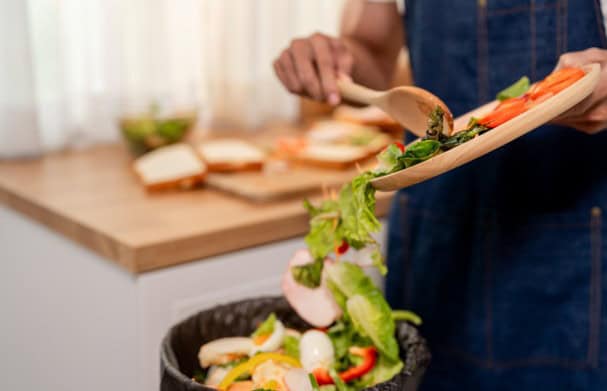
When I lived in Philadelphia, the garbage collectors would sometimes go on strike for a week or more. Trash piled up along the sidewalks, and in the summer, the smell made it impossible to ignore. It wasn’t just garbage. It was food – wasted, rotting, and unavoidable.
That experience stayed with me. It made me think differently about what we throw away and how easily it disappears from view. What if everything we bought had to stay with us?
The question points to something deeper. Food waste is not just about what we throw away, but how our systems are designed. From what happens before food reaches our homes to how ingredients are used and preserved, there are opportunities to reduce waste in ways that are often overlooked.
Where Food Waste Really Starts
Food waste is often seen as a problem in the home, and in many ways it is. Research from the Department of Agricultural, Environmental, and Development Economics (AEDE) estimates that about 43% of food waste comes from everyday decisions in the home like over-purchasing, labeling confusion and improper storage, making individuals the largest contributors.
Food Waste at Home
Concerns about food safety, such as odor, appearance, and date labels, often lead people to throw food away. At the same time, many expect to eat everything they buy but end up using only a portion.
Confusion around labels adds to the problem. Terms like “best by” and “use by” are often mistaken for safety warnings, when they usually refer to food quality. As a result, food that is still safe to eat is often thrown away too soon.
Waste Before Food Reaches the Store
A significant amount of waste happens earlier – even before it hits your fridge. Crops are left in fields, produce is rejected for appearance, and food spoils during transport or storage before it ever reaches stores. By the time it gets to our homes, part of it has already been lost.
A Shift in How We See Food
As awareness grows, people are starting to see food scraps differently. Instead of waste, they see something usable in their gardens or fit for repurposing. This shift makes it easier to use food fully and is now influencing how larger food systems approach waste.
What a Closed-Loop Food System Looks Like
In a system designed to minimize waste, very little is thrown away. The Amish community near me offers a clear example of how this works in practice.
Their approach is simple: Use as much as possible and waste very little.
- Food waste is composted, fed to livestock, or returned to the soil, while leftovers are reused in the kitchen.
- Preservation plays a key role, with foods dried, fermented, or canned, and seeds saved for future crops.
Why Scale Changes Everything
The Amish approach works well at a small, local level, but modern food systems operate on a much larger scale. Food often travels long distances by truck and moves through multiple stages before reaching stores. Along the way, there are more chances for spoilage and loss.
Supermarkets also manage large inventories, which increases the risk of food being thrown away if it is not sold in time. Because of this scale, closed-loop systems are harder to maintain.
Instead, larger systems rely on innovation to reduce waste. Ingredient solutions, processing techniques, and improved storage all help keep food usable for longer periods. Some systems also use pricing strategies to sell food before it expires, reducing the amount that gets discarded.
While large systems cannot work exactly like small communities, they are beginning to apply the same idea. When more of what is produced is used, less is wasted.
How Ingredient Innovation Reduces Waste
Ingredient innovation helps reduce waste by using more of each ingredient and extending its shelf life including upcycled ingredients, natural and functional preservation and NutriFusion’s role.
Upcycled Ingredients
Parts of food that were once discarded, such as peels, pulp, and seeds, are now processed into functional ingredients used in new products. This reduces waste while creating new value.
Common examples include:
- Fruit peels turned into fiber or flavoring ingredients (homemade limoncello)
- Vegetable pulp used in powders or food blends
- Seeds processed into oils or nutrient-rich additives (lavender seeds)
Natural and Functional Preservation
Preservation methods are also evolving. Some products rely on synthetic preservatives, while others use natural approaches such as plant-based compounds, organic acids, and fermentation. These methods help slow spoilage and maintain quality.
The Role of NutriFusion
Companies like NutriFusion apply these ideas at a larger scale by turning fruits and vegetables into stable, nutrient-rich powders. This helps preserve nutrients, extend shelf life, and improve efficiency while still using real, plant-based sources.
Processing Methods That Help Food Last Longer
In addition to ingredients, food preservation techniques help reduce waste across the supply chain. Several processing methods help extend shelf life and reduce waste:
- Canning: Seals and heats food so it can be stored safely for long periods
- Dehydration and freeze-drying: Remove moisture to slow spoilage and improve storage
- High-pressure processing: Uses pressure to eliminate bacteria while maintaining quality
- Cold storage systems: Improve refrigeration and transport to reduce spoilage
Designing a More Efficient Food System
In many cases, the challenge is not that food cannot be used, but that systems have not always made it easy to redirect it. States with stronger infrastructure, such as composting programs, food recovery organizations, and recycling systems, are able to divert more surplus food away from landfills and into reuse pathways.
There have also been changes at the policy level. In the United States, the Bill Emerson Good Samaritan Food Donation Act helps protect businesses that donate food in good faith. This makes it easier for grocery stores and restaurants to give surplus food to organizations instead of throwing it away.
Additionally, New York City has made composting mandatory and introduced fines for not separating food waste. Connecticut is one of the states that wastes the least food due to its food waste disposal ban.
A Different Way to Think About Waste
That question still stays with me. What if nothing we bought could leave our property? I’m not sure I could live like the Amish (without electricity), but there is something to learn from them.
We can waste less food. And at a larger scale, better systems and smarter use of ingredients are already moving us in that direction. Maybe the goal is not perfection. Just wasting a little less.
NutriFusion
NutriFusion can help! NutriFusion develops all‐natural fruit and vegetable powders that are nutrient dense for when you do not have access to fresh produce…and even when you do to improve your vitamin intake. Sourcing only whole, non-GMO foods, NutriFusion offers consumers a concentrated micronutrient and phytonutrient-rich food ingredient blends. With a farm-to-table philosophy, NutriFusion’s proprietary process stabilizes the nutrients from perishable fruits and vegetables, allowing a longer shelf life and access to vital nutrients.
NutriFusion does help through its fruit and/or vegetable powders that are used in foods, beverages, supplements, and pet foods. Visit us at www.nutrifusion.com.

Author Bio
Harley Grandone is a writer and landscape designer. When not writing, she spends her free time visiting farmers’ markets and having fun with her family in the Philadelphia suburbs.